
In an era dominated by speed and efficiency, the ability to calculate quickly is no longer optional—it is essential. Whether you are a student preparing for competitive exams, a professional handling data-driven tasks, or an entrepreneur managing financial computations, mastering fast calculation tricks can dramatically improve your productivity. Unlike traditional methods, which often rely on slow, step-by-step procedures, Lightning Fast Calculation Tricks focus on pattern recognition, mental shortcuts, and strategic thinking. These methods allow you to process numbers at remarkable speed, making complex problems manageable and even enjoyable.
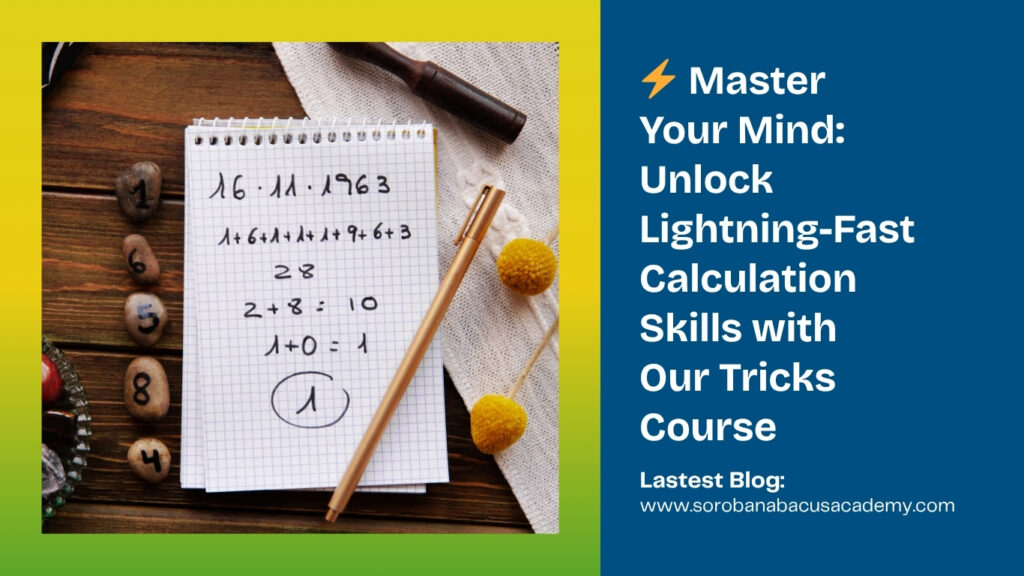
Lightning Fast Calculation Tricks also boost confidence. When faced with numerical challenges, people often hesitate or make mistakes under pressure. With the right techniques, however, you can respond instantly, improving both your accuracy and your overall decision-making ability. Beyond academics and business, these skills enhance your mental agility and strengthen cognitive functions such as memory, focus, and analytical reasoning.
Understanding the Basics of Fast Calculation
Before diving into advanced techniques, it is crucial to understand the foundational principles of fast calculation. These principles are based on simplifying numbers, identifying patterns, and using mental strategies rather than relying solely on pen and paper.
One fundamental concept is the decomposition of numbers. For instance, breaking 47 × 36 into (40 + 7) × (30 + 6) allows easier multiplication by handling smaller, manageable parts. Another key principle is approximation, which can quickly estimate results before fine-tuning them for precision. Transitioning from conventional methods to these shortcuts might seem challenging initially, but consistent practice strengthens your numerical intuition.
Addition Tricks for Instant Calculations
Addition may seem straightforward, but when numbers become large or the context requires speed, even simple sums can slow you down. Fast addition tricks rely on grouping, rounding, and compensating.
For example, adding 497 + 386 can be simplified by rounding 497 to 500 and 386 to 390, giving 500 + 390 = 890. Then, adjust by subtracting the difference: 890 – 3 – 4 = 883. This method saves time and reduces calculation errors. Additionally, visualizing numbers on a mental number line helps process sums faster and keeps track of adjustments more intuitively.
Subtraction Shortcuts That Save Minutes
Subtraction often trips people up, especially with borrowing across multiple digits. Fast calculation courses teach methods such as complement subtraction and reverse thinking.
Complement subtraction turns the problem into an addition task. For instance, to calculate 1000 – 347, find the complement of 347 relative to 1000, which is 653. This avoids step-by-step borrowing and accelerates mental processing. Similarly, breaking numbers into hundreds, tens, and units simplifies complex subtractions, particularly when handling financial statements or large datasets.
Multiplication Made Easy
Multiplication is where fast calculation tricks shine most clearly. Standard multiplication can be tedious, but techniques like the distributive property, squaring shortcuts, and pattern recognition reduce effort significantly.
Consider multiplying 23 × 21. Instead of multiplying directly, split it into (20 + 3) × (20 + 1). Then compute each part: 20 × 20 = 400, 20 × 1 = 20, 3 × 20 = 60, and 3 × 1 = 3. Sum these: 400 + 20 + 60 + 3 = 483. These techniques become almost automatic with practice, allowing you to multiply even larger numbers quickly.
Division Techniques for Rapid Solutions
Division can appear intimidating, but fast calculation courses simplify it through methods like chunking, estimation, and factorization. Chunking divides the dividend into manageable parts.
For example, dividing 784 by 8 can be broken into 800 – 16. Dividing each part separately gives 800 ÷ 8 = 100 and 16 ÷ 8 = 2, so the result is 98. Estimation strategies help verify answers mentally, ensuring both speed and accuracy.
Tricks for Squares and Square Roots
Squaring numbers and extracting square roots are common in exams and business computations. Tricks such as the difference of squares and nearest base method allow rapid results.
To square 47, notice it’s near 50. Using the formula (50 – 3)² = 50² – 2×50×3 + 3² = 2500 – 300 + 9 = 2209. Square roots follow a similar logic; identifying nearest perfect squares allows mental approximation and adjustment, drastically reducing calculation time.
Lightning Fast Calculation Tricks for Fractions and Decimals
Handling fractions and decimals quickly requires pattern recognition and conversion skills. Converting fractions to decimals, simplifying fractions before operations, or using common multiples are key strategies.
For example, 7/8 × 16/5 can be simplified by canceling common factors: 7 × 2 / 5 = 14/5 = 2.8. Such tricks eliminate unnecessary calculations and ensure rapid, accurate results.
Mental Math for Competitive Exams
Competitive exams demand speed under pressure. Fast calculation tricks offer students a significant edge. Techniques like cross multiplication, Vedic math shortcuts, and digit sum methods accelerate problem-solving while reducing errors.
These strategies also enhance memory and concentration. When practiced regularly, candidates can approach problems intuitively, allowing them to allocate more time to complex questions while handling simpler computations almost instantly.
Real-Life Applications of Fast Calculations
Fast calculation skills extend far beyond exams. In finance, retail, and logistics, quick computations improve efficiency. A cashier calculating discounts mentally, a stock trader evaluating positions instantly, or an engineer estimating measurements—these scenarios benefit directly from fast calculation mastery.
Moreover, such skills reduce dependency on calculators and spreadsheets, fostering independent decision-making and increasing self-reliance in professional environments.
Common Mistakes and How to Avoid Them
Even advanced practitioners can fall into calculation traps. Over-reliance on memory, skipping steps too quickly, or neglecting verification can lead to errors. Fast calculation courses emphasize double-checking results mentally and using estimation to validate answers.
By recognizing common pitfalls, learners can maintain both speed and accuracy. Consistent practice, combined with strategic methods, ensures that mistakes are minimized and confidence grows exponentially.
Using Patterns and Tricks to Multiply Faster
Certain number patterns simplify calculations drastically. For instance, multiplying by 11 can be done by summing adjacent digits. Multiply 11 × 34: sum digits 3 + 4 = 7, then place the sum between original digits: 374.
Other patterns, such as multiplying numbers ending in 5, squares of numbers ending in 5, or sequential number multiplication, provide shortcuts that save valuable time. Recognizing and internalizing these patterns is key to mental agility.
The Role of Memory in Fast Calculations
Memory plays a crucial role in mastering calculation tricks. Remembering multiplication tables, squares, cubes, and common fractions allows instant recall, minimizing computational delays.
Techniques such as chunking information, using mnemonic devices, and practicing regularly strengthen both short-term and long-term memory. A robust memory enables faster reasoning and reduces reliance on external tools, which is essential for competitive scenarios.
Practical Exercises to Sharpen Skills
Theory alone is insufficient. Daily exercises, timed drills, and real-world problem simulations are vital. Start with simple sums, gradually increasing difficulty. Track your time and accuracy to monitor improvement.
Exercises should also include estimation, pattern recognition, and mental shortcuts. Using diverse practice material prevents boredom, reinforces learning, and ensures that techniques are adaptable across contexts, from exams to workplace challenges.
How Technology Can Assist in Learning
Apps, online courses, and interactive platforms complement traditional learning. They provide instant feedback, adaptive challenges, and gamified experiences that enhance motivation and engagement.
By integrating technology with manual practice, learners can track progress, refine strategies, and maintain a consistent learning schedule. Technology does not replace mental calculation; rather, it reinforces it through structured guidance.
Making Fast Calculations a Habit
Consistency is the ultimate key to mastery. Integrating daily calculation challenges into your routine ensures gradual yet permanent skill development.
Start with 10–15 minutes per day. Gradually increase complexity and timing constraints. Over time, the mind develops shortcuts naturally, turning fast calculation from a learned skill into an intuitive habit that becomes second nature.
Conclusion
Lightning Fast Calculation Tricks is more than just a skill—it is a mindset. By mastering mental shortcuts, patterns, and estimation strategies, you unlock potential that extends far beyond numbers. Students gain an edge in exams, professionals enhance efficiency, and anyone with a curiosity for mental agility enjoys sharper cognitive abilities.
Enrolling in a Lightning Fast Calculation Tricks course equips you with the tools, techniques, and practice needed to succeed in any number-related challenge. It is an investment in your mind, confidence, and future—transforming tedious arithmetic into an exciting mental workout. With dedication, these tricks can redefine how you approach numbers, making you not only faster but also more accurate and insightful.